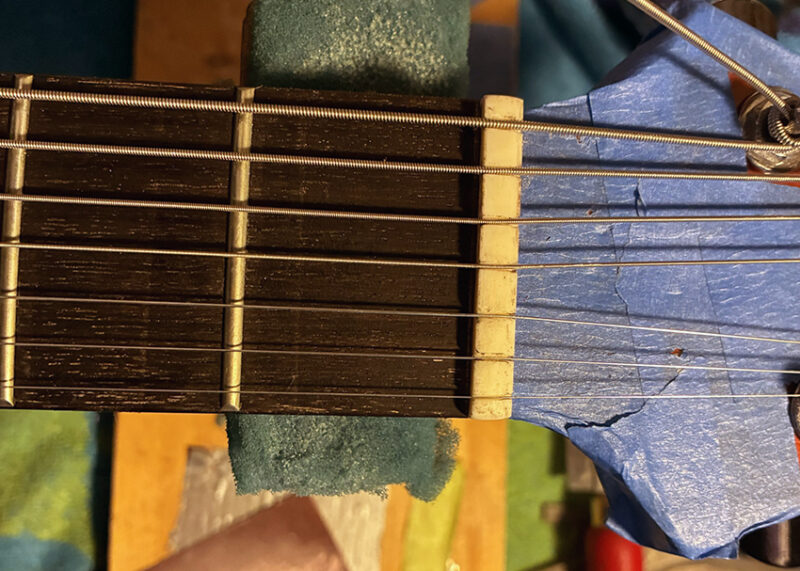
Do you want an 8-string guitar but currently only have a 7-string? While zZounds’ Play as You Pay installment plans are helpful, buying a new axe isn’t always a feasible option. In this guide, I’ll go over a method to extend your 7-string even lower into the 8-string range and the tools you’ll need to do so. However, as with any guitar modification, you should always weigh the pros and cons before jumping into action.
Pros and Cons
With this process, the pros likely speak for themselves: by modding your 7-string guitar to fit a thicker gauge string, you could truly djent or thall to your heart’s content without investing in a new instrument.
And while I tend not to be a very negative person, I think the cons deserve some focus. If you’re going to do this, you’ll need to file your nut to accept larger-gauge strings. Essentially, we’ll be taking your current strings, sliding them down one space on your nut and bridge, and adding a big boy into that 7th slot. As a result, you’ll lose what would traditionally be your high E string.
One important factor to consider is which string gauges work best for your scale length—and whether pre-made packs in those gauges are readily available or not.

Final Warning:
Filing your nut for a larger gauge is a one-way journey. If you later decide this setup isn’t for you, you’ll need to replace the nut and file the new one for 7-string gauges. Modifications like this can void your zZounds 45-day return policy and, in some cases, your manufacturer’s warranty. Please make sure you consult the manufacturer before making any major modifications.

How to Do This the Right Way
You might ask, “Why can’t I just use the new string to wear down the nut and let it fit itself?” There are several reasons why this is a bad idea. A thicker gauge string can bind inside the nut and cause tuning instability, intonation issues, excessive string breakage, and that dreaded “pinging” sound. It can also wear the nut unevenly, causing alignment and spacing problems.
Don’t make the mistakes I did — like when I crudely forced a 5-string gauge into my 4-string bass. It broke off the bass end of the nut. By the time it had formed a deeper groove, there wasn’t enough material left to hold the string under tension, and it eventually snapped.
Lastly, avoid putting smaller strings into a nut filed for larger ones; the most likely result is fret buzz.
String Gauges and Tension
Now that you’ve learned from my mistakes, let’s dig into the real brain-buster: picking the right gauge strings for your scale length. This can be a bit subjective, depending on how you like your action.

If you’re curious, check out the string tension calculators on Stringjoy or D’Addario’s websites. For a 25″ scale tuned down to an 8-string’s F#, I’d suggest a .074 gauge string. For a 27″ scale, go all the way up to .080. On my PRS 7-String SE Custom 24 (25″ scale), I use the D’Addario NYXL 8-string Light Top/Heavy Bottom set: .074, .064, .054, .042, .030, .017, .013, and .010. Plus, I now have an endless supply of .010s for my other guitars in case I break a high E.
At zZounds, you’ll find a ton of string gauge and material options available, and you can even customize your own string packs directly on D’Addario’s site.
The Tools and The Process
Now it’s time to dig in! As long as you don’t have a locking nut like a Floyd Rose, I would suggest getting a blank bone nut, however, there are tons of different materials to choose from and others may suit your needs better. Once you’ve picked your poison, you’ll only need a few tools to get the job done: Nut files, a string spacing ruler, nut slotting gauge and a string action gauge.

Nut files are often more affordable in a pack and give you a variety of options. I like this pack from Music Nomad as it works for most of my guitars and my basses. However, I had to get an single file for my lowest string as this pack doesn’t offer a suitable sized file for my preferred .074 gauge.
When filing a guitar’s nut it’s okay to go a couple thousands of an inch bigger than needed. When comparing the Music Nomad file set to my string preferences, I used the .065 file for my 3rd string gauged at .064 and similar sizing throughout several other strings. The only other things to consider when filing a guitar nut are alignment with the bridge (string spacing), the slot height, and the string angle. A deeper guide on this can be found in David’s post “Five Factors That Make a Good Guitar Nut.”
Related: Five Factors That Make a Good Nut
While the nut on your guitar is one of the smallest parts of your instrument, it is still one of the most influential on the tone, intonation and overall playability. Get yours right with this guide! | Read »

Final Adjustment

After filing the nut, you’ll likely need to adjust your truss rod to provide more neck relief for the added tension. In case you don’t know, that’s a clockwise turn. When adjusting the truss, I start with a quarter turn and let the guitar adjust over half-hour increments, repeating until the guitar is stable and holding tension properly. But please — if you’re not confident or sure how to do this — call your guitar tech and schedule an appointment today.