
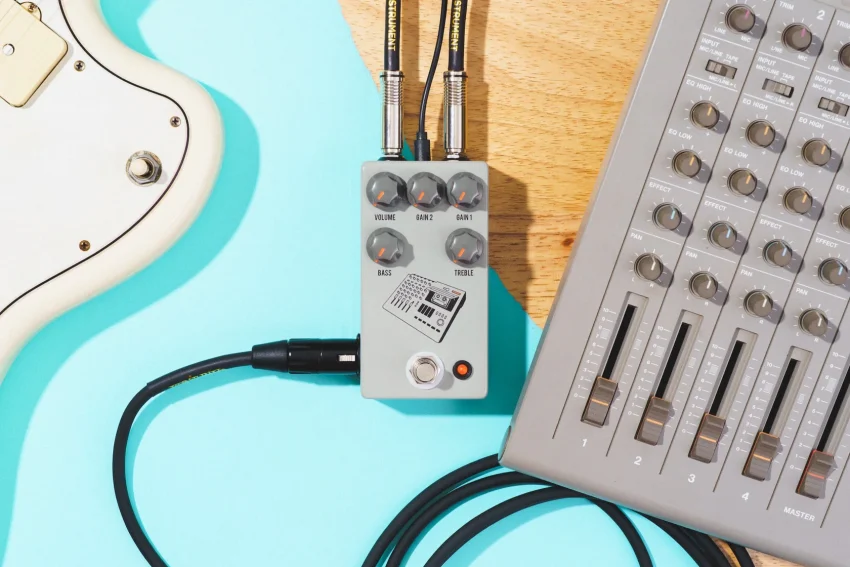
Some pedals are born out of nostalgia, but the JHS 424 Gain Stage is rooted in obsession. For years, producers and guitarists have been chasing the gritty, colorful saturation of the TASCAM 424 Portastudio, the four-track cassette machine that defined an era of lo-fi records. From indie bands layering tape hiss into their mixes to modern players like Mk.gee shaping entire guitar tones around it, the 424 became more than a recorder. It was an instrument in its own right.
JHS took that magic and distilled it into a stompbox. The result is a pedal that doesn’t just add gain, it adds character: midrange grit, harmonic glue, and the option to blend a miked amp with a DI signal for studio-ready tones. The JHS 424 Gain Stage isn’t about transparency, it’s about color, and it gives guitarists, producers, and engineers a new way to reach that coveted Portastudio saturation without hunting down an old tape machine.

The Portastudio Legacy
In the late 1980s and 1990s, the TASCAM 424 Portastudio was everywhere. It was affordable, portable, and simple enough that anyone could record a song at home. But what stuck with musicians wasn’t just its accessibility, it was the sound. Push the gain too hard and the preamps would break up in a way that was imperfect, but musical. Drums felt glued together, vocals sat in the mix with just enough grit, and guitars picked up a raw edge that couldn’t be faked with clean digital gear.
Over time, that character became a sought-after texture. Entire albums were made with the 424 not in spite of its quirks, but because of them. The 424 offered the sound of tape compression, of limitations turned into creativity, and of imperfections that make a recording feel alive. The JHS 424 Gain Stage takes that legacy and shrinks it into something you can kick on with your foot.

What the 424 Gain Stage Does
At its core, the JHS 424 Gain Stage emulates the exact gain structure of the TASCAM 424. That means you’re not just getting “analog-style” saturation, you’re getting the same circuit response that musicians fell in love with. Plug in, crank it, and you’ll hear the same kind of harmonic buildup and low-end compression that tape machines delivered when pushed.
The pedal also includes a direct input and output, letting you blend a miked amplifier signal with a DI, just like producers used to do with the original Portastudio. This makes the 424 Gain Stage not only a creative tool for guitarists, but a versatile box for anyone working in a recording environment who wants to be transported to the world of analog recording, without using a cassette.
Turn the knobs lightly and you’ll get a subtle fattening effect that makes clean tones sit forward in a mix. Push it harder and it becomes aggressive, with all the crunch and edge of a cassette deck driven into the red. It doesn’t matter if you’re running a Tele through a tube amp or a synth through an interface, the 424 Gain Stage reacts musically to anything you throw at it.
Lo-Fi Character, High-Impact Results
What separates the JHS 424 Gain Stage from typical overdrive pedals is its focus on coloration over clarity. This isn’t about “amp in a box” realism or transparent boost. Instead, it’s about sculpting recordings with a distinct, lo-fi identity. Think of it as adding tape saturation at the front end of your signal chain, with the ability to control exactly how much glue, grit, and texture you want.

That’s why the pedal appeals not just to guitarists, but to producers and engineers who want to bring cassette-style saturation into a DAW setup. Run it on a vocal chain, a drum machine, or even a stereo bus: it consistently responds the same way the Portastudio once did. It doesn’t just distort, it transforms.
The JHS 424 Gain Stage isn’t about chasing perfection. It’s about capturing a sound that defined decades of DIY recording and making it usable in any context. Whether you’re stacking layers of gritty guitar tracks, gluing together a rhythm section, or just adding a touch of warmth to an otherwise sterile setup, this pedal delivers the unmistakable character of the TASCAM 424 in a format built for today’s players and producers.



Leave a Reply